From NASA
Right: a Leonid fireball captured by photographer Darren Talbot on Nov. 18, 2001. [more]
“I am sure I could hear several of the meteors,” recalled Karen Newcombe, a Leonid watcher from San Francisco — one of many who reported meteor sounds to Science@NASA on Nov. 18th. “Several times when a Leonid with a persistent debris train flew directly overhead, I heard a faint fizzing noise [instantly].” There was no delay between the sight and the sound.
“How is that possible when the meteor was so many miles above my head?” she wondered
From Edmund Haley
The same question has bedeviled some of history’s greatest scientists. For example, in 1719 astronomer Edmund Halley collected accounts of a widely-observed fireball over England. Many witnesses, wrote Halley, “[heard] it hiss as it went along, as if it had been very near at hand.” Yet his own research proved the meteor was at least “60 English miles” high. Sound takes about five minutes to travel such a distance, while light can do it in a fraction of a millisecond. Haley could think of no way for sky watchers to simultaneously hear and see the meteor.
Baffled, he finally dismissed the reports as “pure fantasy” — a view that held sway for centuries.

Willamette Meteorite. Are all of those round, internal holes created by the atmosphere??
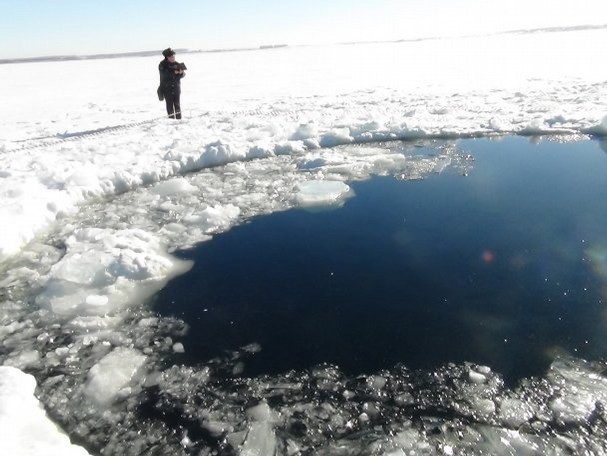
Maxim, a University student from the town of Yemanzhelinsk, 30 miles south of Chelyabinsk, who for privacy reasons didn’t want his last name used, claims to have collected several dozen pieces of what he believes to be meteorite particles. He said he decided to keep the biggest, weighing 18 grams, and gave a dozen of the smallest ones to a visiting scientist. Now he is selling about seven pieces, at roughly six grams each, via the Internet.
“When the explosion happened [Friday] morning I was driving outside my town through a snow-covered field and had to stop my car and get out, scared as hell, because it looked for a moment as if the sun fell down on the Earth,” he said in a phone interview. “And then I heard several loud explosions and felt a gust of very strong wind that nearly pushed me off my feet as my parked car rattled.”
Then, he said, “I heard hissing sounds all around me in the field and noticed tiny white tongues of steam rising from the snow all over the field. Not far from where I stood, I found several pieces of black rock in the snow that looked like porous coal. They were still hot.”
From Me:
As those “meteors” heat up, burn up, break up and even explode and expose those micro black hole nuclei, the nuclei take off and accelerate in our mass-energy dense atmosphere at sub-relativistic to relativistic speeds, also creating a string or filament behind them as they go. That is why observers hear hissing noises while the meteor is sometimes many miles away, it is spitting collapsed matter at them, some of which is probably passing right through them at times and into the ground. This collapsed matter may contain thousands to millions or more tons of “missing” dark matter. I also believe we will find it accumulating in the tails and debris trails of comets.
Godspeed
This work is licensed under a Creative Commons Attribution-NonCommercial-NoDerivs 3.0 Unported License.

References
Copyright 2012 Stewart D. Simonson All Rights Reserved
Imagine your daily, sometimes dull experience as you are rotating on the surface of the Earth which orbits the sun which orbits within the galaxy. Imagine that you sense gravity and time passing, you see light, you touch the Earth, you feel the wind, you see the lightning, you hear the thunder, you touch the rain, you taste the matter that touches your lips.
Now, let’s imagine that you are orbiting 3959 miles from a black hole at a speed of approximately 1000 miles per hour through space atop an accretion of Earthen matter that is orbiting with you. Imagine that black hole is expelling jets of smaller black holes from its poles at thousands of miles per second, orbiting over your head and into the other pole, protecting you within sort of an electromagnetogravitational(I made that word up) wormhole in spacetime. Imagine the first black hole is orbiting another black hole 93 million miles away at speeds of 60,000 miles per hour. Imagine the larger black hole and you are orbiting a “galactic center” black hole at 220 miles/sec through space at the same time. Now imagine that the larger black hole is also expelling and exchanging micro black holes with your black hole and they are orbiting around and through you and coalescing at speeds of hundreds and thousands of miles per second, actually up to the speed of light and radiating low energy black body radiation such as photons. Imagine that those black holes forming “strings” around you are creating gravitational, thermodynamic, electromagnetic and low energy nuclear transformations, which our senses perceive as “life” on “Earth”. You also then realize the missing 95% is right here with us, you had just not turned on your sixth sense, or quantum sense.
From “Bekenstein-Hawking entropy” by Jacob D. Bekenstein
Black hole entropy counts the number of states or excitations of a fundamental string.
Strings in string theory have a variety of excitations, so there is a multitude of string states. Therefore, a string has entropy, which turns out to be proportional to its mass. This is quite in contrast with black hole entropy. However, an argument by Bowick, Smolin and Wijewardhana (1987) suggests that by adiabatically (i.e. sufficiently slowly) reducing the string coupling constant g , it is possible to shrink a black hole’s size as well as to reduce its mass (while keeping its entropy constant) until eventually it gets to be the size of the string length scale ls when the black hole should not be distinguishable from a string. At the corresponding value of g , string and black hole entropy are quite similar (see e.g. Zwiebach 2004). This has been taken to mean that there is a one-to-one correspondence between black hole and string states, where both entities have the same entropy (Susskind 1993). This picture has been corroborated in the context of five-dimensional extreme black holes (Strominger and Vafa 1996). Hence black hole entropy can be understood in terms of string entropy.
Godspeed.
This work is licensed under a Creative Commons Attribution-NonCommercial-NoDerivs 3.0 Unported License.
References
Copyright 2012 Stewart D. Simonson All Rights Reserved
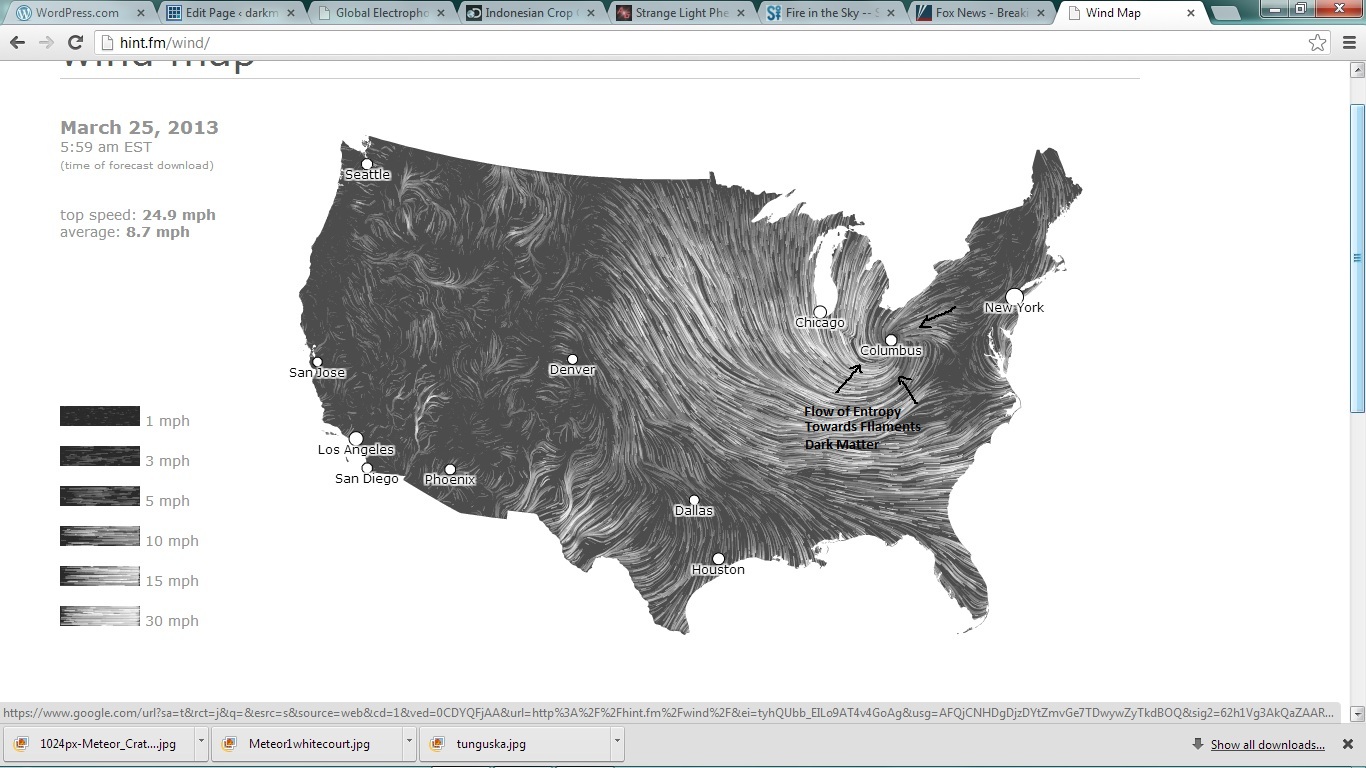
3-25-13 Wind Map
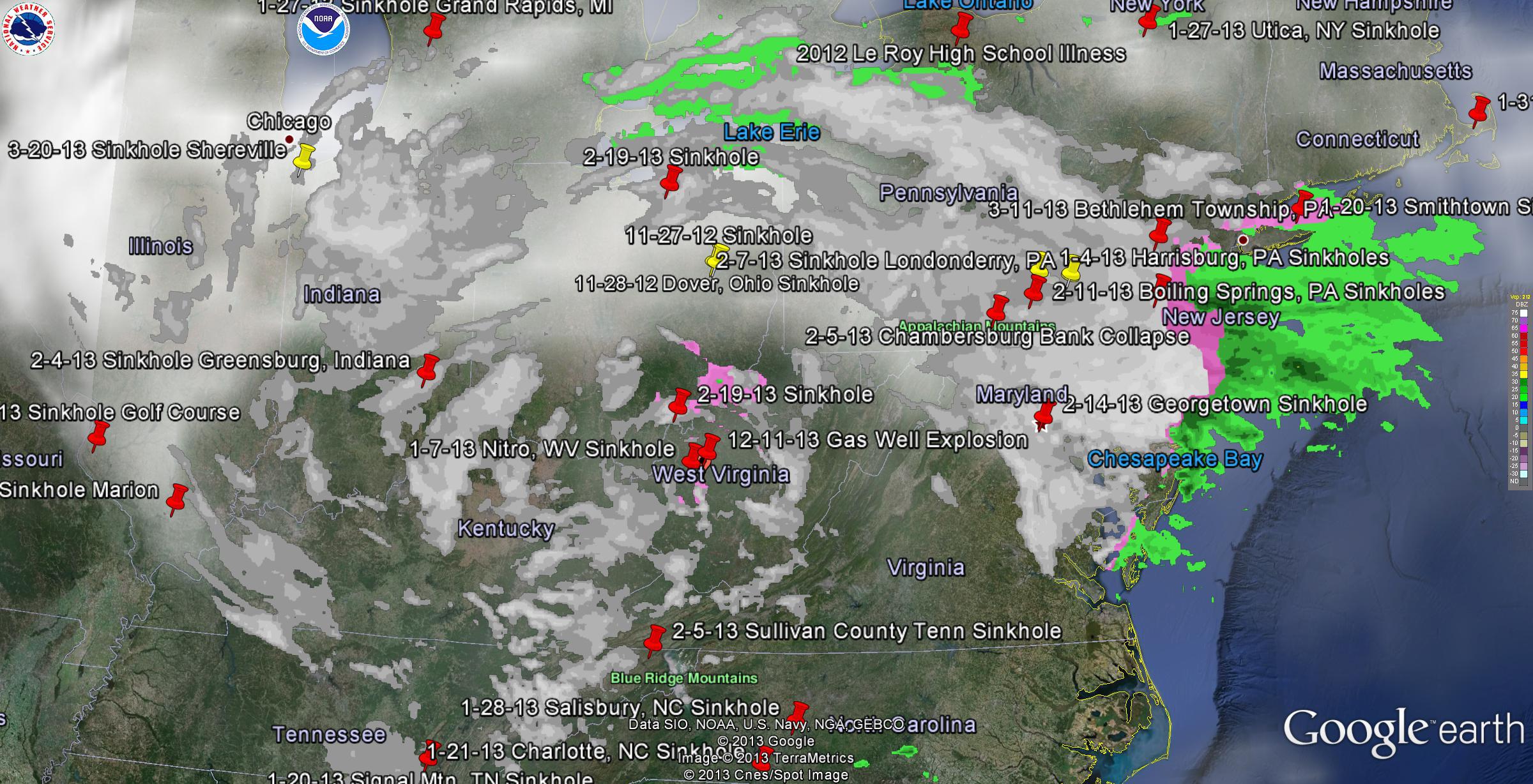
3-25-13 Google Earth Weather
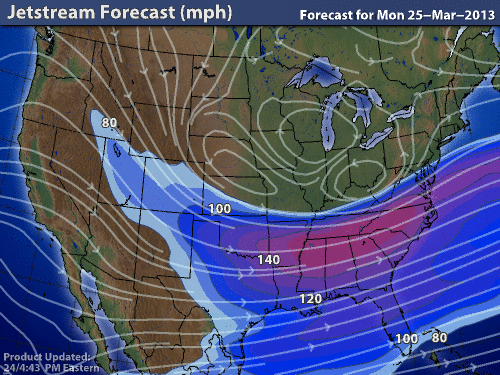
3-25-13 Jet Stream
Good Video. They missed the collapsed, dark matter created from the collision of hydrogen and the filaments/strings formed but that is OK. Plasma is another word that is overused because it sounds cool, ie. “Hey dude, awesome, it looks like plasma”. Not all of that cool dude “plasma” stuff enters at the poles, some of it makes it through our entropic shield and is orbiting through and around our heads, creating the thermodynamic and electromagnetic atmospheric upsets we call the weather and killing us quite often. We just need to get our heads out of the sand.

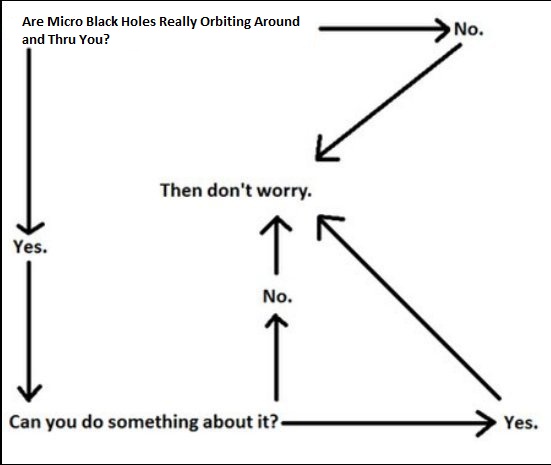
 No piles of snow to be seen or meteor chunks here
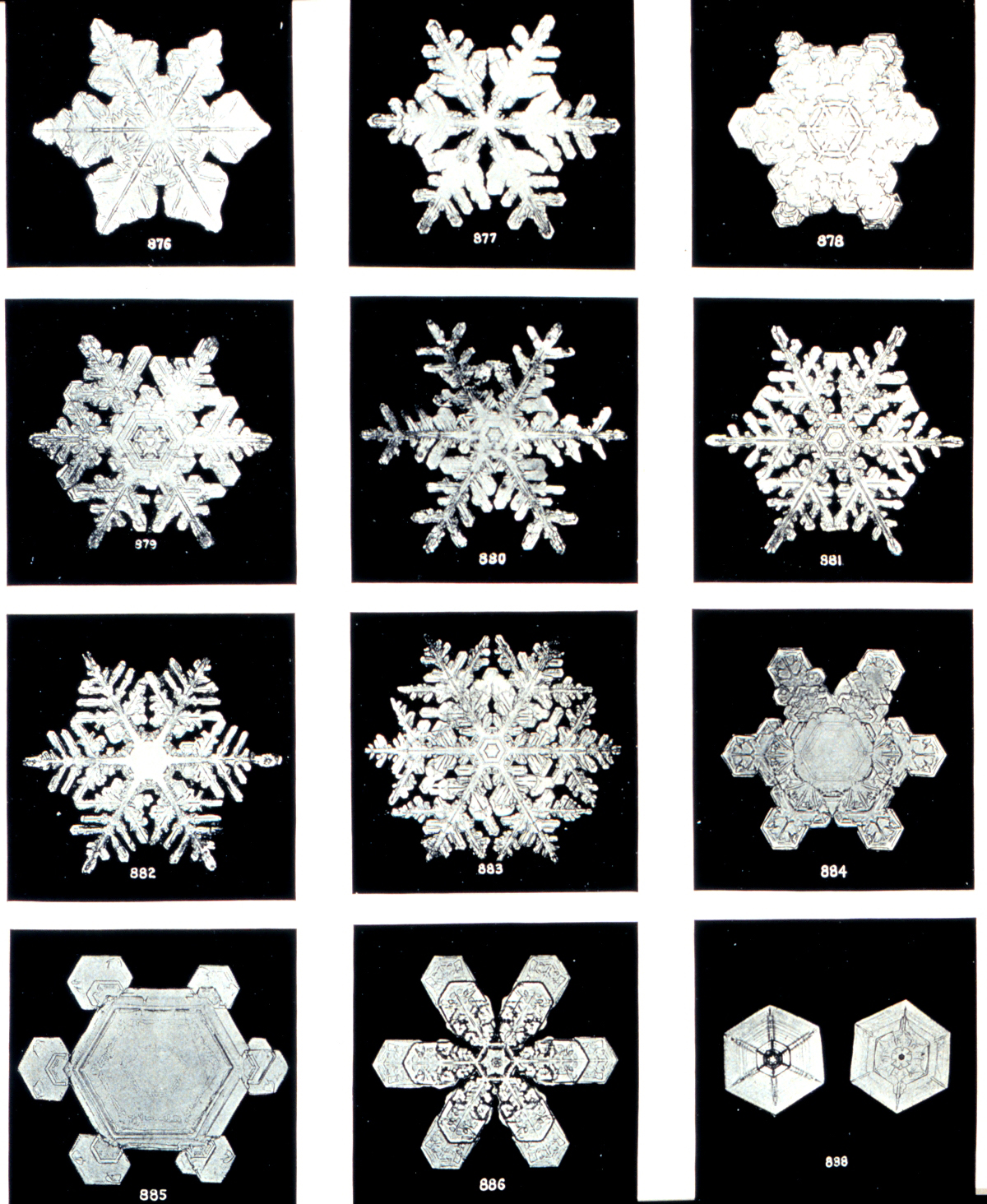 NOAA says there was a dust particle at the center, I’m not so sure that it was not another type of particle sucking entropy and creating beautiful patterns…

Godspeed
 Did you know there are lots of reports of hissing meteors, electromagentic meteors, nuclear explosive yielding meteors? Some meteors are as bright as the sun and other meteors appear to accelerate, blink off and on and change direction? Does this really sound like the behavior of metal and rock to you?
Why is it that most all of the largest meteorite craters on Earth have relatively little meteorite stuff lying around? Does tens of thousands of tons of material just vaporize? If the object vaporized in the air, why such a big hole??
From the American Meteor Website:
Meteoroids of more than about 10 tons (9,000 kg) will retain a portion of their original speed, or cosmic velocity, all the way to the surface. A 10-ton meteroid entering the Earth’s atmosphere perpendicular to the surface will retain about 6% of its cosmic velocity on arrival at the surface. For example, if the meteoroid started at 25 miles per second (40 km/s) it would (if it survived its atmospheric passage intact) arrive at the surface still moving at 1.5 miles per second (2.4 km/s), packing (after considerable mass loss due to ablation) some 13 gigajoules of kinetic energy.
Currently, the fastest commercially available rifle round is the 220 Swift, which travels around 1.3 km/s. So bullets, which are made of soft metal do not “vaporize” into thin air when you shoot them into a tree or the ground. So why does a 10,000 TON meteorite mostly vaporize? I have not heard of any pieces of the Russian meteor found yet over a few pounds. Why did the Tunguska object, which resulted in an explosion up to 500 times larger than the recent Russian object, also appear to vaporize? All that was found were a bunch of empty holes in the ground.
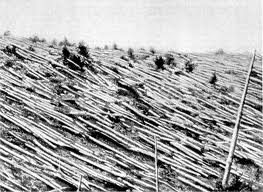 The spectacle that confronted Kulik as he stood on a ridge overlooking the devastated area was overwhelming. To the explorers’ surprise, no crater was to be found. There was instead around ground zero a vast zone (8 kilometres [5.0 mi] across) of trees scorched and devoid of branches, but standing upright. Those farther away had been partly scorched and knocked down in a direction away from the centre. Much later, in the 1960s, it was established that the zone of leveled forest occupied an area of some 2,150 square kilometres (830 sq mi), its shape resembling a gigantic spread-eagled butterfly with a “wingspan” of 70 kilometres (43 mi) and a “body length” of 55 kilometres (34 mi).[21] Upon closer examination, Kulik located holes which he erroneously concluded were meteorite holes; however, he did not have the means at this time to excavate the holes.
If you are at ground zero, why would those trees still be standing? If you are standing at ground zero of a 15 MEGATON bomb blast, wouldn’t you fall on your ass?
During the next ten years there were three more expeditions to the area. Kulik found several dozens of little “pothole” bogs, each some 10 to 50 metres (33 to 160 ft) in diameter, that he thought might be meteoric craters. After a laborious exercise in draining one of these bogs (the so-called “Suslov’s crater”, 32 metres [105 ft] in diameter), he found there was an old stump on the bottom, ruling out the possibility that it was a meteoric crater. In 1938, Kulik arranged for an aerial photographic survey of the area[22] covering the central part of the leveled forest (some 250 square kilometres [97 sq mi]).[23] The negatives of these aerial photographs (1,500 negatives, each 18 by 18 centimetres [7.1 by 7.1 in]) were burned in 1975 by order of Yevgeny Krinov, then Chairman of the Committee on Meteorites of the USSR Academy of Sciences.[23] It was done under the pretext that they were a fire hazard, but the truth may have been the active dislike by official meteorite specialists of anything associated with an unyielding enigma. However, positive imprints would be preserved for further studies in the Russian city of Tomsk.[24]
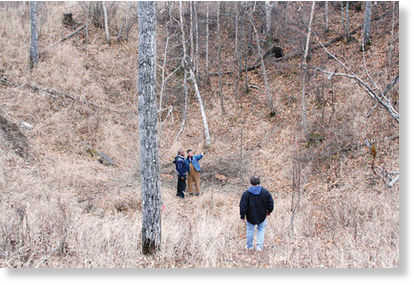 This huge sinkhole in Canada is now thought to be a meteorite crater because bits and pieces of something have been found. That is an awfully big depression.
The meteorites found around the crater have sharp edges, which tell researchers a story about what might have happened to the meteor before it hit the ground. …The rock was ripped apart on impact or at a low altitude,” Herd said. “Otherwise the atmospheric pressure would have rounded (the edges of the meteorites)
There ought to be a very big hunk of iron there somewhere, but NOT.
The Arizona meteor crater looks a lot like a big square sinkhole. Square?? Again, where is the missing meteorite stuff?? I can think of some overlapping quantum orbit patterns that might result in a square area of decay.
It was not until 1960 that later research by Eugene Merle Shoemaker would confirm Barringer’s [meteorite] hypothesis. The key discovery was the presence in the crater of the minerals coesite and stishovite, rare forms of silica found only where quartz-bearing rocks have been severely shocked by an instantaneous overpressure. It cannot be created by volcanic action; the only known mechanism of creating it is through an impact event (or artificially through a nuclear explosion).[21][22]
 You see, dark matter micro black holes can generate Beta decay and Low Energy Nuclear Reactions at their surface and can transmute any of the minerals you see listed above.
Sound generated by a meteor in the upper atmosphere, such as a sonic boom, is typically delayed for many seconds after the meteor disappears. Occasionally, as with the Leonid meteor showerof 2001,”crackling”, “swishing”, or “hissing” sounds have been reported,[31] occurring at the same instant as a meteor flare. Similar sounds have also been reported during intense displays of Earth’s auroras.[32][33][34][35]
So why are the Earth’s auroras hissing?? Ah ha, because they also contain much of the same STUFF. It is electromagnetic and thermodynamic Vacuum STUFF. It is Dark ENERGY STUFF and it is a massive amount of energy.
I am going to link you to the video once again of that little girl before the 2011 Virginia Earthquake. I believe that “swishing” sound is actually a SUCKING sound from vacuum energy from a micro black hole entering the Earth and triggering the subsequent earthquake as it weakened the Earth thru beta decay.
Godspeed

US Navy Photo
Scientists believe they have explained what caused the Hindenburg to explode back in May 1937.
The Concorde of its day, the Hindenburg was a technological marvel that was capable of transporting passengers across the Atlantic in half the time of a sea-based vessel. Disaster struck in 1937 however when the airship burst in to flames as it came in to land at Lakehurst, New Jersey. For years experts have pondered over what exactly caused it to explode, but now a team of engineers think they may have the answer.
Using a small scale model of the airship, the team led by aeronautical engineer Jem Stansfield was able to piece together the series of events that conspired to destroy the Hindenburg. It turns out that the hull became charged with static during an electrical storm while at the same time a broken wire or faulty valve leaked hydrogen in to the ventilation shafts. “I think the most likely mechanism for providing the spark is electrostatic,” said Stansfield. “That starts at the top, then the flames from our experiments would’ve probably tracked down to the centre. With an explosive mixture of gas, that gave the whoomph when it got to the bottom.”
I think our particle, along with creating the electromagnetic spark, can also trigger the leak.
I’m just saying…
Godspeed


 Dark Matters a Lot