
The Worst Single Day
 A remarkable series of aircraft crashes occurred within the span of a month at or near Tokyo airport in the Spring of 1966. A fifth rescue aircraft also almost crashed in the same area. What are the chances? Time magazine did an article on the events that unfolded. Below is a summary
“Death haunted the skies of Japan last week. Near towering Mount Fuji, a British Overseas Airways’ Boeing 707 fell from the sky, killing all 124 persons on board. Only the day before, a Canadian Pacific DC-8 crashed while landing in heavy fog at Tokyo Airport, killing the ten-member crew and all but eight of the 62 passengers. This total of 188 in less than 24 hours made it, as far as anyone could remember, the darkest single day in the history of commercial aviation.
And that was not all of it: two Japanese crewmen died when their S-58 helicopter toppled into Tokyo Bay while on a search for bodies from last month’s worst single-plane disaster in history, the crash of the All Nippon Airways’ 727 that killed 133 persons.
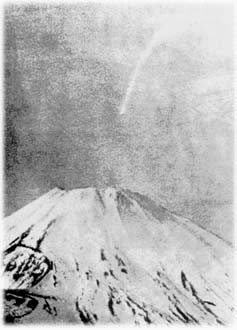
BOAC’s flight 911 had taken off in perfect weather twelve minutes before the disaster from Tokyo International and had climbed to 6,000 feet. The passengers were probably peering out the starboard windows for a glimpse of the mountain. Among them were 75 dealers and executives with their wives from Minneapolis’ Thermo King Corp., on a 14-day company-paid tour of the Far East, a reward for outstanding sales. Suddenly witnesses on the ground saw the plane belch white, then black, smoke. To some it seemed to come apart in midair, pieces of wing and tail fluttering to earth like dry leaves. Presumed cause: either a mid-air explosion or disintegration as a result of turbulence from the very strong gusts of wind that prevailed around Mount Fuji that afternoon.
 Ironically, the doomed 707 had just taxied out for its takeoff past the wreckage of Canadian Pacific’s Hong Kong-to-Tokyo flight. On the night before, it circled fog-closed Tokyo International for nearly an hour, hoping for a break in the overcast. Finally, its pilot gave up and informed the control tower and his passengers that he was making for Taiwan, 1,300 miles to the southwest. At that moment, the visibility momentarily increased to five-eighths of a mile at the airport, just above the minimum safety standard, and the pilot elected to land instead.
His radar-directed approach was perfect until he was only a few hundred yards short of the runway. Then the control-tower radar scanner saw in horror that the huge DC-8 suddenly had sunk twenty feet below the correct glide path. “Level off,” commanded the tower operator. Seconds later, the plane dropped off the radar screen. Too low, the plane’s wheels apparently snagged on the breakwater at the edge of the runway, sending the DC-8 cartwheeling down the field.”
I believe these crashes were all triggered by orbital weakly interacting massive energetic particles (micro black holes) in the area. They may have orbited for a couple of months. I believe this for the following reasons.
1. All of the aircraft crashed due to some unforeseen turbulence and/or mechanical failures that occurred at or near Tokyo airport.
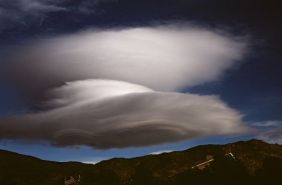
2. Lenticular clouds were seen in the area. I believe lenticular clouds are many times the sign of an energetic particle orbiting up through the Earth and creating a condensed contrail ring of clouds in their path.
3. Extreme fog condensed directly over the end of the runway before one of the accidents. I have already shown that the elliptical arc of an orbiting particle that can condense anything in its surroundings and create fog.
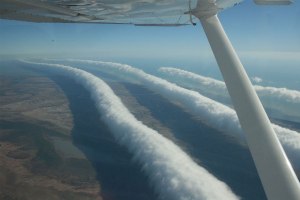 Our atmosphere is just a mixture of gasses. Gasses by their nature want to disperse and do not want to form these precise patterns in space. Whenever that happens it is a sign of the reduction in Entropy of the gas and our world. Entropy by itself leads to randomness. Take that entropy away from our spatial dimensions and into a curled up energetic micro black hole ball and you create beautiful but sometimes deadly cloud patterns in the surroundings. These particles can take on virtually any orbital trajectory.
Best to enjoy these clouds from a distance.
Godspeed
References
Copyright 2012 Stewart D. Simonson All Rights Reserved

This work is licensed under a Creative Commons Attribution-NonCommercial-NoDerivs 3.0 Unported License.


 Dark Matters a Lot
Wow…those look really awesome form above.
They are called “Morning Glory” clouds. Lots of good pictures if you google them.
Human Misconceptions:
1)They do not just appear in the Morning
2)While they appear glorious, they could be deadly to an aircraft according to my research. If you decide to hang glide in them, I would stick to the middle ones where the particle has already orbited through…
Thanks, learning something new everyday.