邪悪な地震や台風
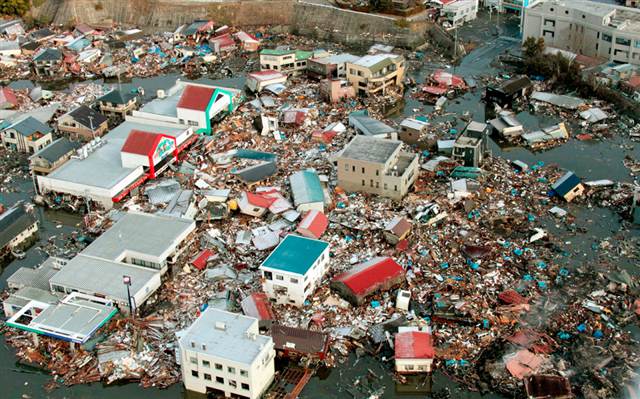 As I have researched papers on Earthquakes, I mentioned before that many times I kept running across evidence of atmospheric effects before, during and after significant events. Current research says there is a “coupling mechanism” which is connecting the Earth to the upper atmosphere. There are also electrical currents within the Earth before and during Earthquakes. I believe this “coupling mechanism” and electrical current is made up of strings/filaments of dark matter/energy, most likely created from the orbital approach and decay of micro black holes entering into orbit through and around the Earth. So I am just going to summarize some of the current Research from the 2011 9.0 Tōhoku earthquake and tsunami and let you read the rest from the links.
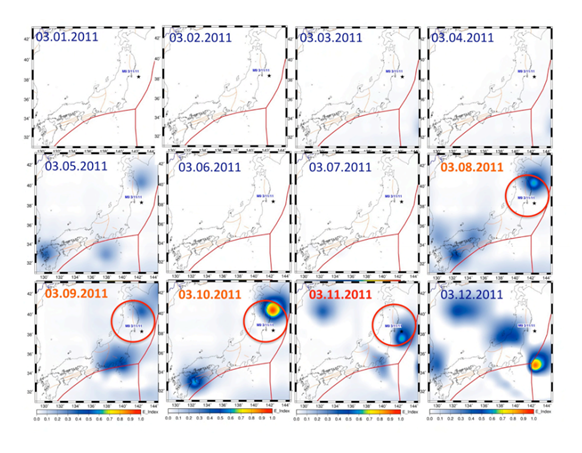 Atmosphere Above Japan Heated Rapidly Before M9 Earthquake
Infrared emissions above the epicenter increased dramatically in the days before the devastating earthquake in Japan, say scientists. They say that before the M9 earthquake, the total electron content of the ionosphere increased dramatically over the epicentre, reaching a maximum three days before the quake struck.At the same time, satellite observations showed a big increase in infrared emissions from above the epicentre, which peaked in the hours before the quake. In other words, the atmosphere was heating up. These kinds of observations are consistent with an idea called the Lithosphere-Atmosphere-Ionosphere Coupling mechanism. The thinking is that in the days before an earthquake, the great stresses in a fault as it is about to give cause the releases large amounts of radon. The radioactivity from this gas ionises the air on a large scale and this has a number of knock on effects. Since water molecules are attracted to ions in the air, ionisation triggers the large scale condensation of water. But the process of condensation also releases heat and it is this that causes infrared emissions. “Our first results show that on March 8th a rapid increase of emitted infrared radiation was observed from the satellite data,” say Ouzounov and co. These emissions go on to effect the ionosphere and its total electron content. It certainly makes sense that the lithosphere, atmosphere and ionosphere are coupled in a way that can be measured when one of them is perturbed. The question is to what extent the new evidence backs up this idea. The Japan earthquake is the largest to have struck the island in modern times and will certainly turn out to be among the best studied. If good evidence of this relationship doesn’t emerge from this data, other opportunities will be few and far between.
Ref: arxiv.org/abs/1105.2841: Atmosphere-Ionosphere Response to the M9 Tohoku Earthquake Revealed by Joined Satellite and Ground Observations. Preliminary Results.
So if my theory were to be correct and the 9.0 Earthquake were triggered by strings of vacuum/dark energy which weakened the Earth at the epicenter, triggering the fault rupture, then at some point afterwards, depending upon the initial momentum and trajectory of the particles, a significant low pressure system should have tracked towards the epicenter as the strings/filament(s) gained in mass and their orbit slowly decayed or coalesced into the Earth. The strings would also create ionizing radiation, such as Radon as they trigger Beta Decay and LENR in any matter contacting their surface.
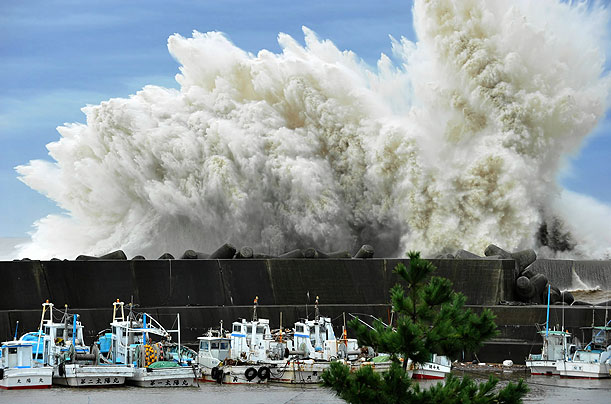
Typhoon Roke (international designation: 1115, PAGASA name: Onyok, JTWC designation: 18W)
In September 2011, Category 4 Typhoon Roke moved significantly fast both inland and over the ocean… Also, the Nissan Motor Company‘s spokesman Chris Keeffe said “workers at its Yokohama headquarters and nearby technical facilities were being told to go home early for safety reasons, and two plants were not operating.”[39] Typhoon Roke caused no immediate problems other than broken security cameras at the Fukushima Dai-ichi nuclear power plant, which had been in its path overnight. The plant had been sent into meltdown by the March 11 earthquake and tsunami, and efforts are still under way to bring the reactors under control.[40]
So below on Google Earth I have plotted the epicenter of the 9.0 Earthquake as well as the track of the Category 4 Typhoon Roke.
 As you can see, the eye tracked very close to the epicenter of the Earthquake. The low pressure system should begin to “wind down” after it passes the epicenter because the particle strings should then go below ground. One thing I have noticed as I have plotted 4 months worth of my proposed strings across the US is that multiple strings tend to entangle and pull multiple low pressure systems together along a similar path, effecting the steering of the low pressure systems as they approach the weakened area of the Earth the particles first entered.
 Depending upon the momentum of the particles as they orbit through and around the Earth, they might induce wobble or possibly cause the Earth to speed up in rotation due to that extra energetic mass locked into the Earth and slowly winding towards her entropic center like a pirouette.
A new analysis of the 9.0 magnitude earthquake in Japan has found that the intense temblor has accelerated Earth’s spin, shortening the length of the 24-hour day by 1.8 microseconds, according to geophysicist Richard Gross at NASA’s Jet Propulsion Laboratory in Pasadena, Calif.
Godspeed
This work is licensed under a Creative Commons Attribution-NonCommercial-NoDerivs 3.0 Unported License.

References
Copyright 2012 Stewart D. Simonson All Rights Reserved


 Dark Matters a Lot