

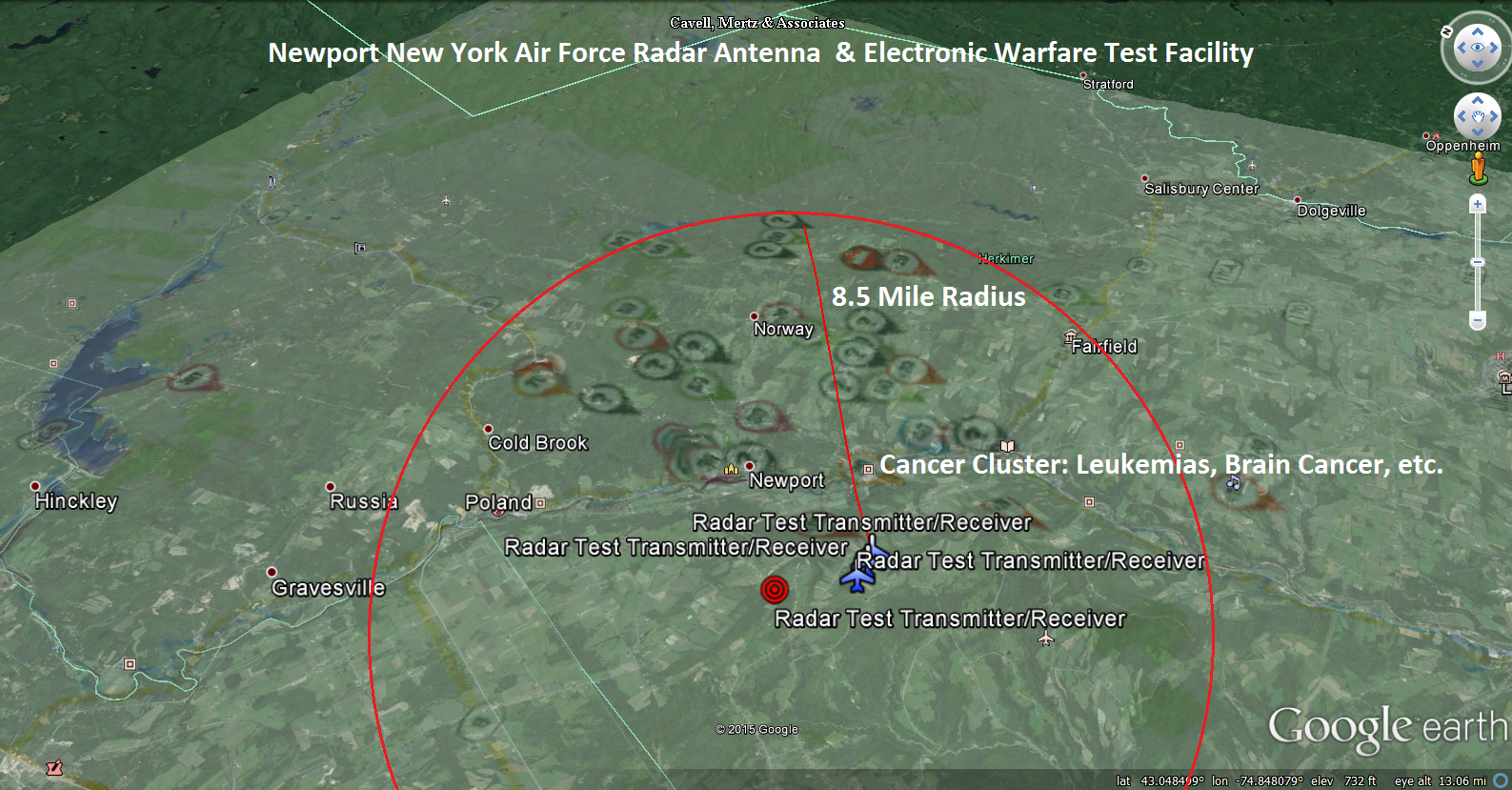
Cancer Cluster around Air Force Electromagnetic Radiation test facility in Newport, NY
Sign Their Petition!
The Government has already checked with their Bankers!

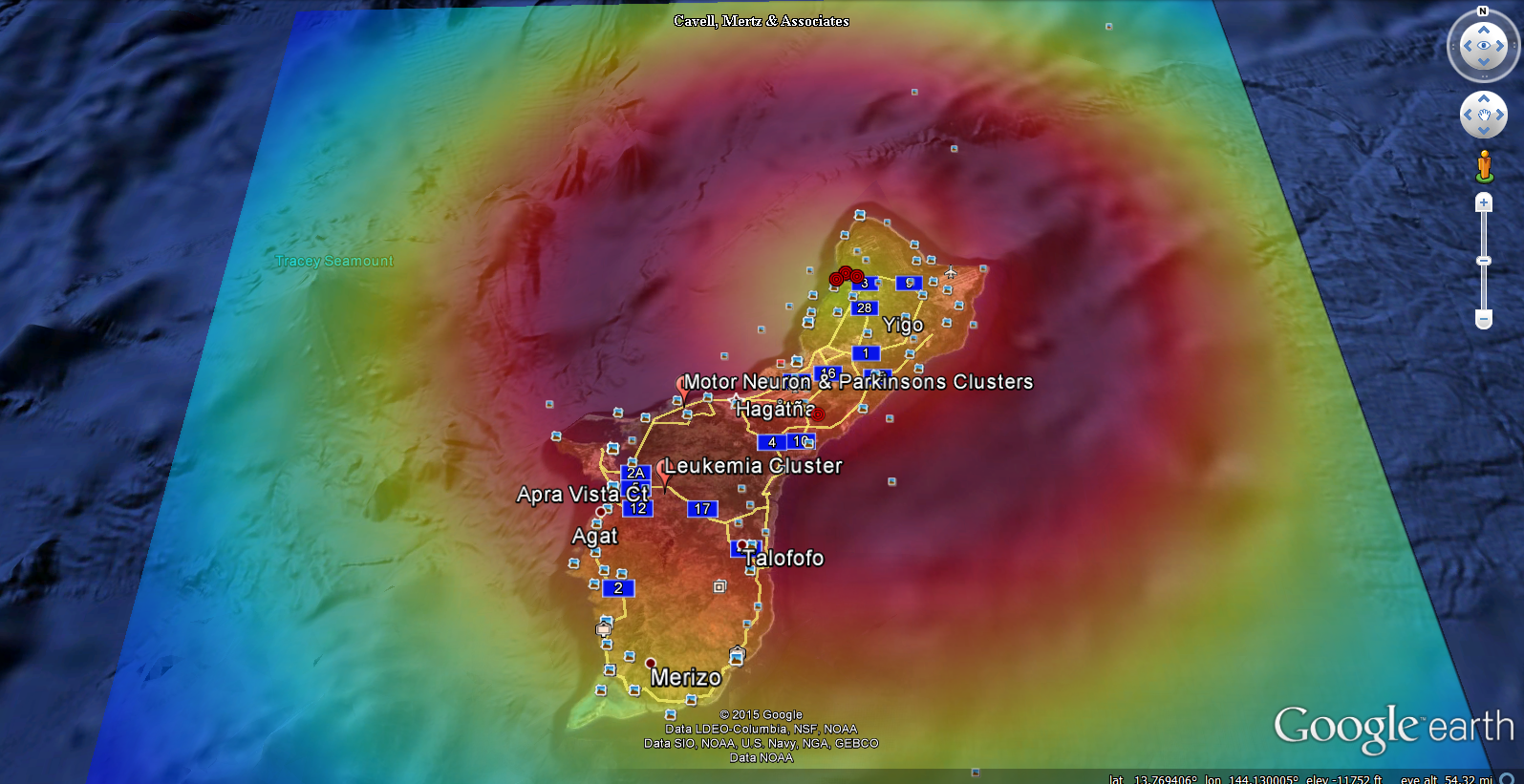
Non-Isometric Scattered Pulsed Electromagnetic Radiation Profile On Guam 25,000 feet avg cloud cover, 5 degree radar angle. Pulsed power density reaching ground/ocean will vary with atmospheric conditions

25,000,000 +/- pulsed watts of high power, high gain microwave radars on Guam. The atmosphere scatters much of the radiation back to the surrounding area.
Back when I researched the excessive motor neuron and parkinsons disease on Guam I forgot to check for Leukemia rates.
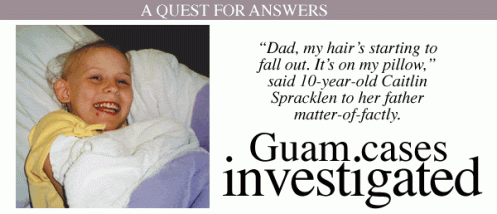
Pacific Daily News
kworth@guampdn.com
“Paul Spracklen leaned down and touched his daughter’s hair, thick and blond, and long enough to drape past the middle of her back.
“Yeah, I know, honey,” he said gently. “We knew that would happen when you started the chemo.”
Caitlin paused. “Well, do you think you could do me a favor and brush it all out?”
Spracklen looked at his daughter blankly. “What do you mean?” he asked.
“Well, if we brush it, we can save it, and we can send it to the wig company, and some other little girl can have it who might need it.”
For a moment, Spracklen just stared at his daughter as they stood in her room in the children’s ward of Balboa Military Hospital in San Diego.
Finally, nodding, he said “Yeah, let’s do that, honey.”
Spracklen sat down behind his daughter and began pulling the brush through her hair in careful, tender strokes. His eyes rimmed with tears as hair came out in threads and clumps. He felt shattered by this girl of his whose little body was waging a fierce war with the leukemia inside her. This girl who, facing a likely death, still managed to think about some other kid down the road who might need a wig.
Tears trailed down his face. Spracklen wept as his daughter’s hair fell in strands through his fingers.”
— As told by Lt. Paul Spracklen
In March 2002, when Caitlin was first diagnosed with leukemia — cancer of the blood — the Spracklens thought of it as a horrible, but isolated, incident. They would soon learn this, tragically, wasn’t the case.
In the months following Caitlin’s diagnosis, Spracklen would learn of more than 10 other children who had been diagnosed with leukemia and other rare cancers. Some survived; others did not.
What did all those children have in common? They had all lived in military housing areas on Guam.
The Spracklens had lived in the Apra Heights military housing complex in Santa Rita from 1998 to 2000 while Spracklen, a lieutenant in the Navy, served on the USS Frank Cable. When his orders changed, the family moved to San Diego, and they were still living there when Caitlin got sick.
After Spracklen began to learn about other sick children, he asked the Defense Department’s investigations arm to do a study on the incidence of leukemia among families who had been stationed on Guam.
After a prolonged and sometimes arduous effort on Spracklen’s part, the Navy finally released the results of that investigation. In their initial search through the military’s medical databases, the Navy had found some 17 military children whose families had been stationed on Guam and who were later diagnosed with leukemia.
However, after looking at the 17 cases more carefully, investigators eliminated all but seven of those children from the study for a variety of reasons, such as their parents were Air Force, not Navy; the diagnosis had been changed; their parents had since retired from the Navy; or a Guam duty station couldn’t be established for some reason.
But even with the seven cases retained, the Navy’s Bureau of Medicine and Surgery said the incidence could be defined as a “cancer cluster” because it was higher than the national average.
The Navy’s Surgeon General asked the Air Force to do a similar study for Air Force dependents. In October 2003, an Air Force office in Texas produced a memorandum on the results of that investigation.
The Air Force calculations suggested “that Air Force children on Guam were three times more likely to develop ALL (Acute Lymphocytic Leukemia) than the national average.” However, there were not enough cases included in the study to be statistically significant, the memo concluded.
At the same time the Navy released the results of the investigation, it also published a fact sheet summarizing the results. The fact sheet stated that the leukemia incidence on Guam “was not large enough to indicate that a problem or an unusually elevated leukemia rate exists.”
Spracklen doesn’t agree. He believes something really wrong may be going on in the military housing areas on Guam, something that has taken children’s lives.”
I previously talked about the Motor Neuron Disease on Guam here
Ask the government where all of that pulsed microwave radiation leaving the radar dishes is going – THEY CAN’T TELL YOU.

 Please be patient while I find a safe place from their radiation
(P.S. I have only had speeding tickets and expired tags, I’m innocent!)

He has cancer now though

See, I told you he was real

He has a new ride designed by these guys

With a new microwave radar designed by these guys
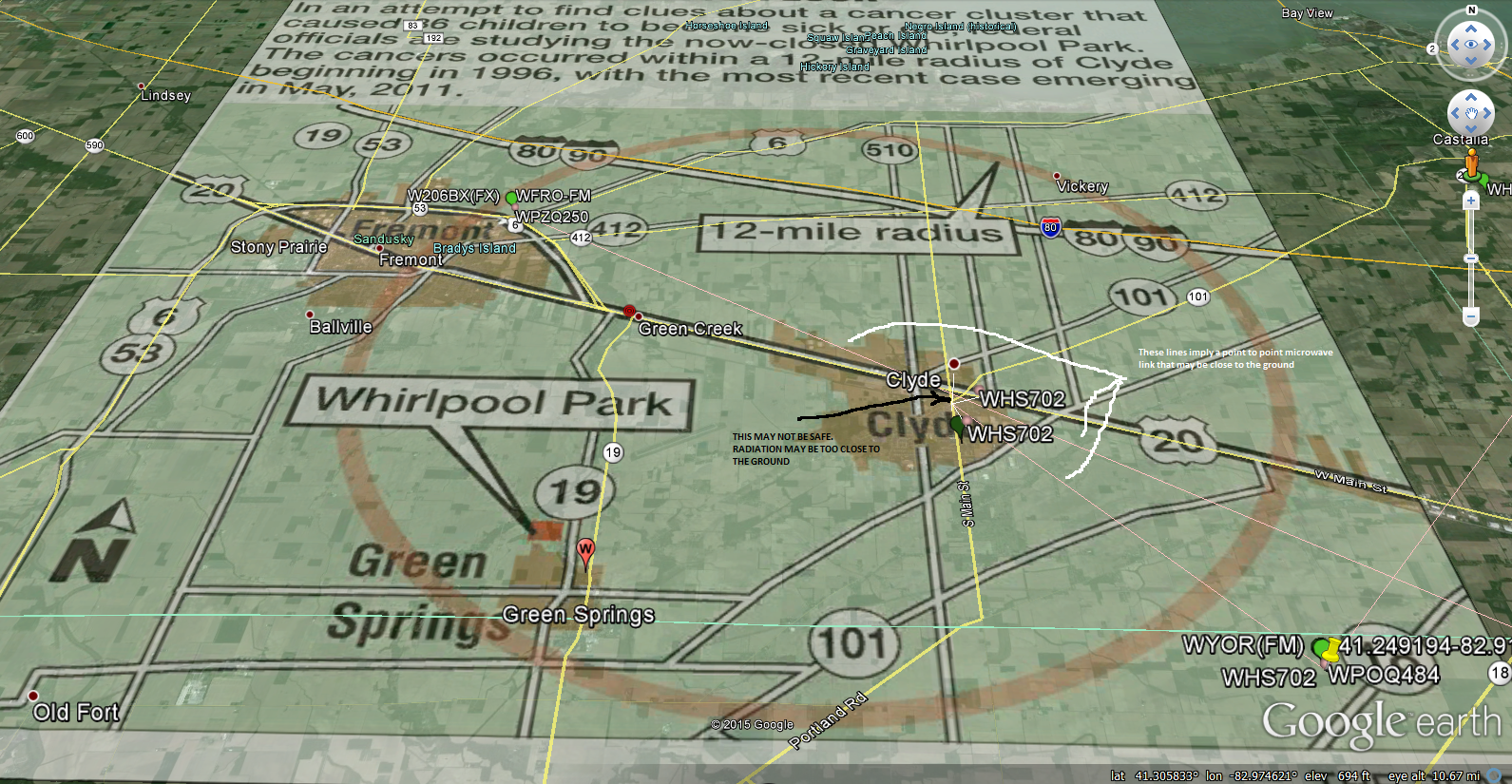
There is a VERY LOW microwave relay antenna in the center of town that the FCC flagged as potentially TOO LOW.
Families of children who became mysteriously sick in the so-called “cancer cluster” of Clyde, Ohio, have hired a private environmental engineer to test for toxic residue in their homes. An Environmental Protection Agency (EPA) investigation previously found dangerous compounds in the soil of a nearby area, but a direct link to the children’s illnesses has not been established. Like other cancer cluster areas, Clyde has an unusually high rate of cancer diagnoses. Since 1996 [microwave tower licensed in 1993-see below], at least 37 children in the area have been diagnosed — and all live within 12 miles of each other. According to local news outlet Toledo Blade, four of these children have died.
http://www.ncbi.nlm.nih.gov/pubmed/21716201
Click to access sec24_2007_Key_Scientific_Studies.pdf

The FCC has pointed out a potential problem with the antenna height. Either it is an entry error or the area of that receiving antenna is getting hosed with RF/microwave radiation.

The Receive Height of this microwave tower shows 0 feet!

Potential EMF Problem in the area of these microwave towers and power line
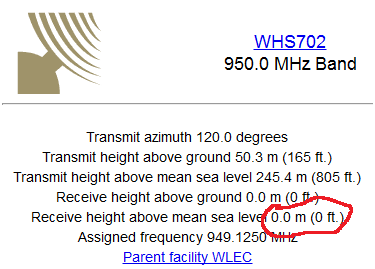
Could be an error but receive height is TOO LOW


 Dark Matters a Lot