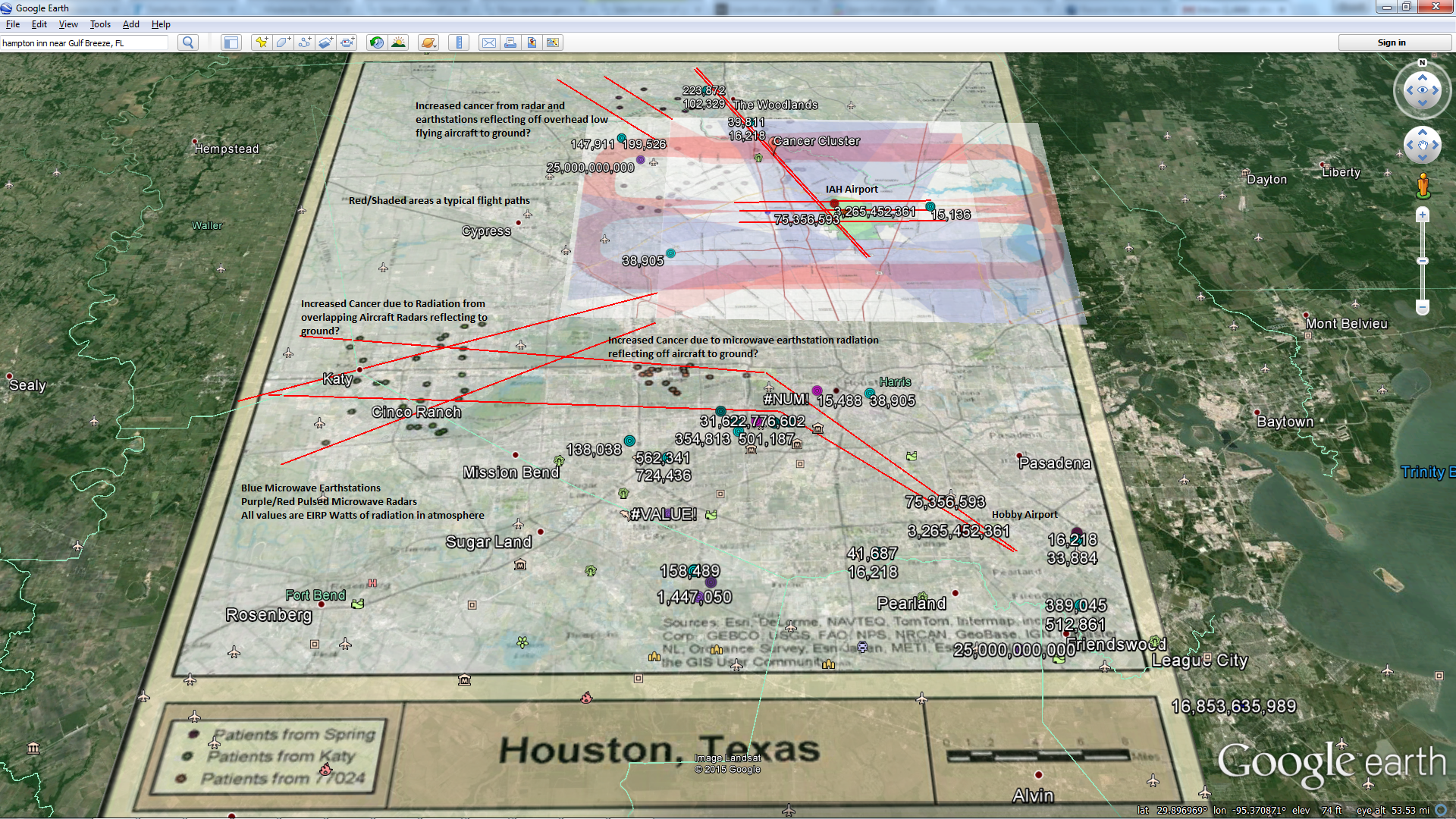
And I’m frightened by those that don’t see it.


———- Forwarded message ———-
From: ChemE Stewart <cheme911@gmail.com>
Date: Mon, Dec 29, 2014 at 6:08 PM
Subject: Charlotte TDWR
To: Government Radar Dudes
Just letting you know your Charlotte TDWR radar is not striking a water tower @ 340 Degrees, it appears to be striking the elementary school or high school or both. They also have an eye cancer cluster in the area.
From: GSP Webmaster
Date: Tue, Dec 30, 2014 at 5:32 PM
Subject: Re: Charlotte TDWR
To: ChemE Stewart <cheme911@gmail.com>
ChemE Stewart,
“Thank you for taking the time to send your message to us. After I received your email, I checked with one of our Electronic Technicians about your concerns with the FAA’s Terminal Doppler Weather Radar (TDWR) at Charlotte, NC (TCLT). I learned that the TCLT TDWR transmission is not blocked by a water tower, as previous information indicated, but the transmitter is intentionally inoperative at the 338 degree radial, for elevation slices below 2.5 degrees, to eliminate microwave interference with a communication tower. Therefore, the TDWR is not collecting data along the 338 degree radial over Long Creek Elementary School for the 0.2, 0.6, and 1.0 elevation scans. “
Sincerely,
Meteorologist
The Problem is…..
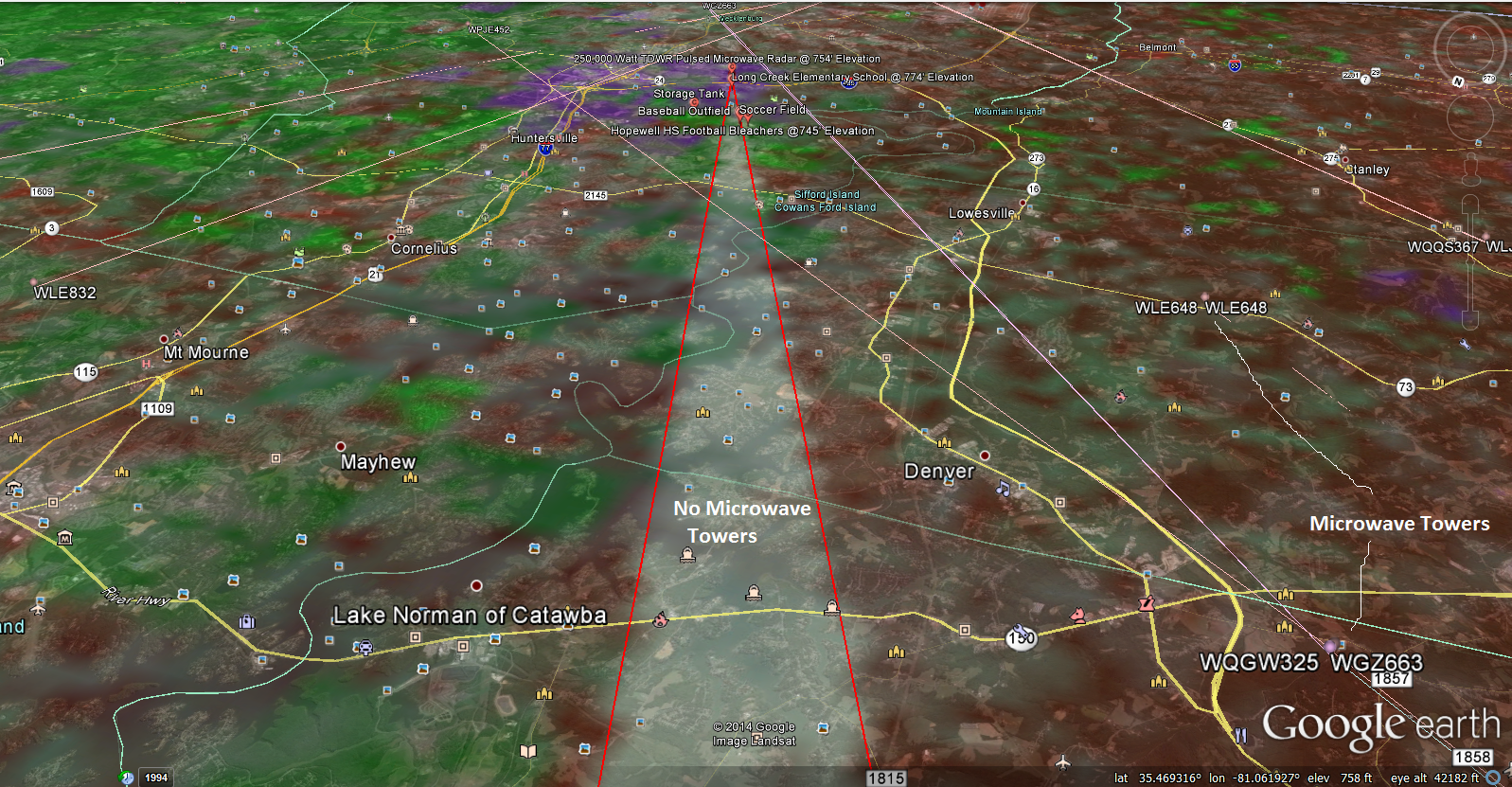
There is NO MICROWAVE COMMUNICATIONS TOWER at 338 degrees in the path of that TDWR radar.

If the TDWR radar high power, high gain pulses are/were striking the area of the elementary school, this is the peak pulsed power. FCC Guideline only deals with “average” pulsed power and THERE IS NO LIMIT TO HOW MUCH POWER THEY CAN PULSE

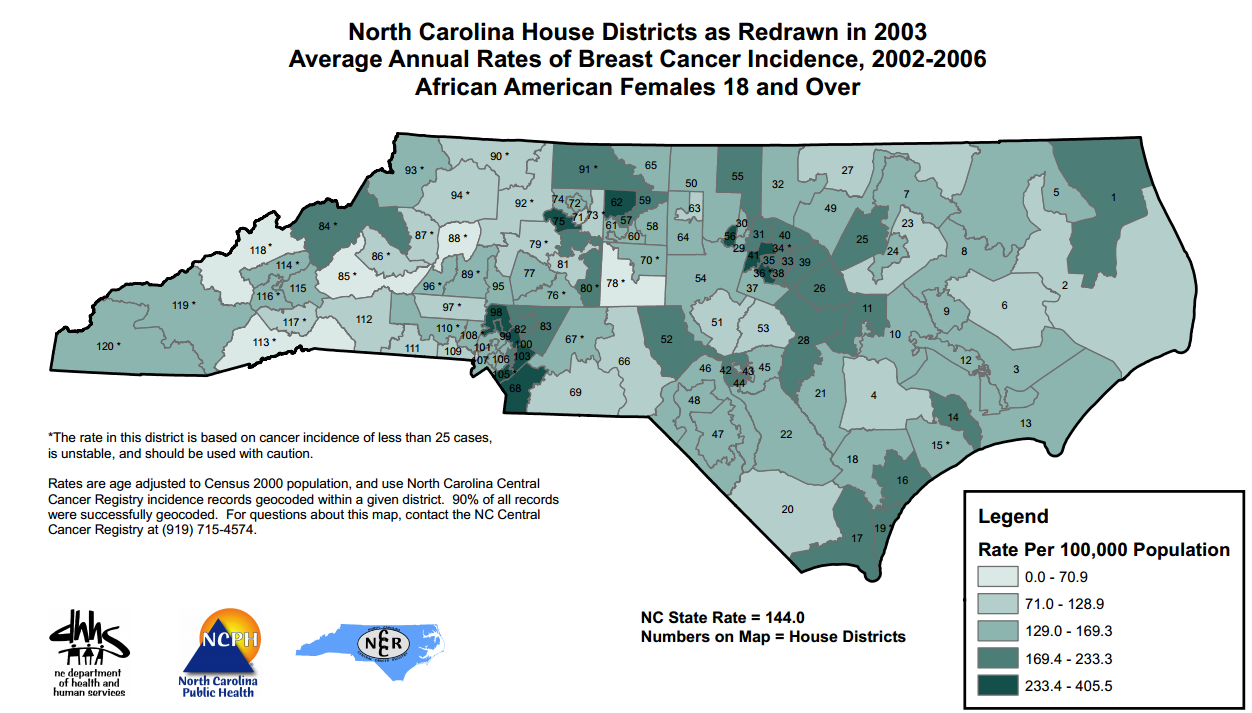

Typical Scattered Pulsed Radiation Power Profile using avg 20,000 ft cloud cover & 20 degree radar dish angle.
Don’t really need a Cray supercomputer to see there is a strong correlation between overlapping pulsed microwave radar power profiles and increased breast cancer rates. I think the basic problem is that the radar physicists made up some make-believe term called “average power” and they included the time the radars are turned off in the calculation and said they were safe because they are “low average power”. Mother nature dissipates that instantaneous, high powered electromagnetic pulse at the speed of light and it is causing damage in all biology as it scatters and grounds out to the Earth below.
Very Sad. Very, Very Sad
The WordPress.com stats helper monkeys prepared a 2014 annual report for this blog.

Here’s an excerpt:
The concert hall at the Sydney Opera House holds 2,700 people. This blog was viewed about 44,000 times in 2014. If it were a concert at Sydney Opera House, it would take about 16 sold-out performances for that many people to see it.

The radar is not hitting a water tower, IT IS HITTING THE SCHOOLS

The radar is not hitting a water tower, IT IS HITTING THE SCHOOLS
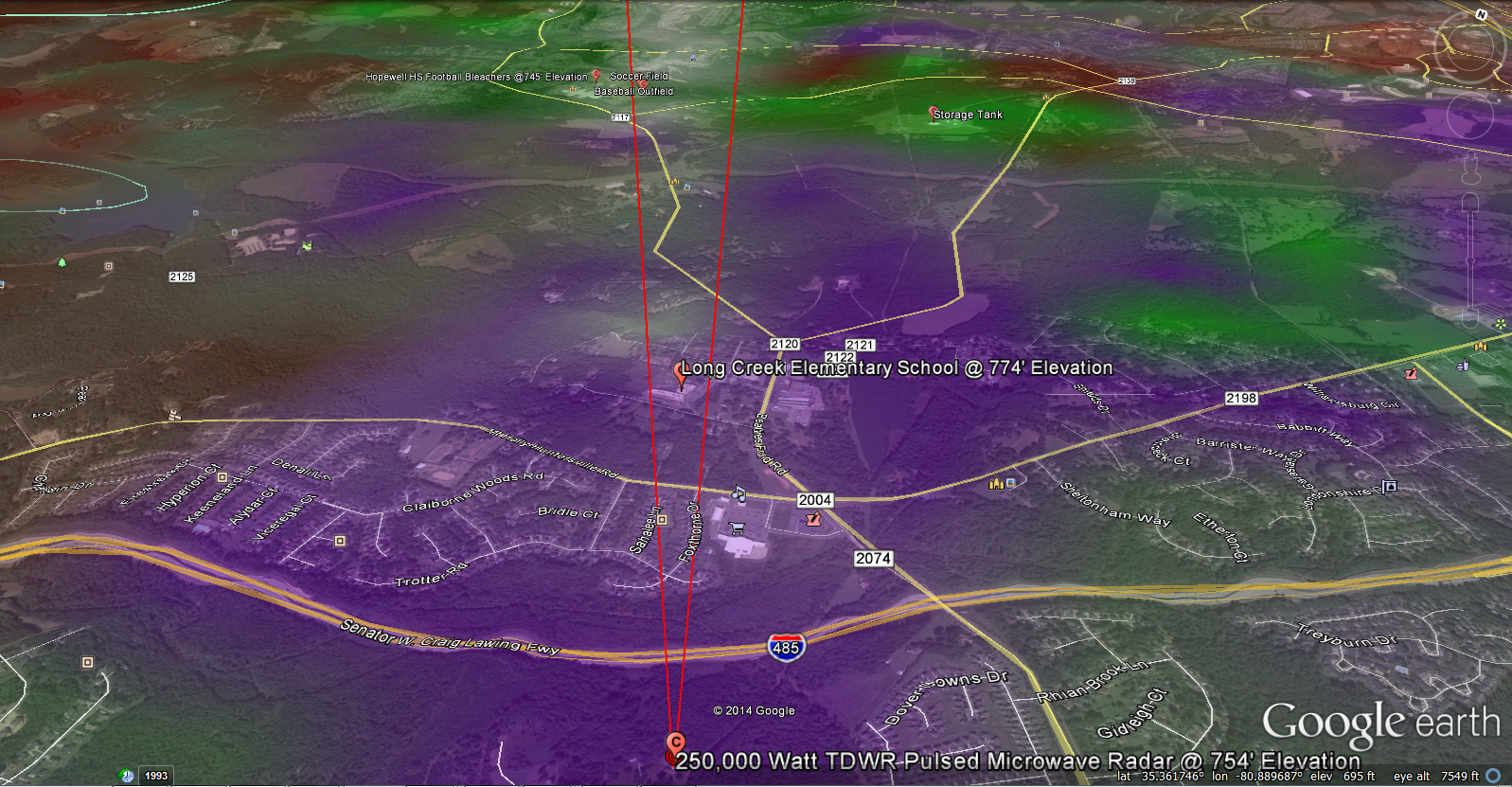
The radar is not hitting a water tower, IT IS HITTING THE SCHOOLS

The radar is not hitting a water tower, IT IS HITTING THE SCHOOLS

The radar is not hitting a water tower, IT IS HITTING THE SCHOOLS
———- Forwarded message ———-
From: ChemE Stewart <cheme911@gmail.com>
Date: Mon, Dec 29, 2014 at 3:52 PM
Subject: Re: Microwave ocular melanoma
To: confidential
You might also want to check if the ocular melanoma patients went to Long Creek Elementary School. The school is closer to and directly in line between the radar station and the high school. It is also much higher in elevation( 774′) than the high school (745′ elevation) and higher than the hill the radar is on @ 754′ elevation and would collect more radiation, and the graphics imply that it is. Using basic antenna calculations @ 0.9 miles(1.4 km) I am getting 1015 Watts/sq. meter pulses =101,500 microwatts / cm2 pulses=101.5 mW/cm2 pulses)in the area of the elementary school on the hill from the 250,000 watt pulsed radar. The radar was installed in 1995/96
Don’t believe me, download the kml file and open in Google Earth. If you can find a water tower blocking the radar I will send you a check for $100. It appears to be either the elementary school on the hill or the high school or BOTH. Somebody needs to falsify my claim FAST.
Click on link below to download kml file.
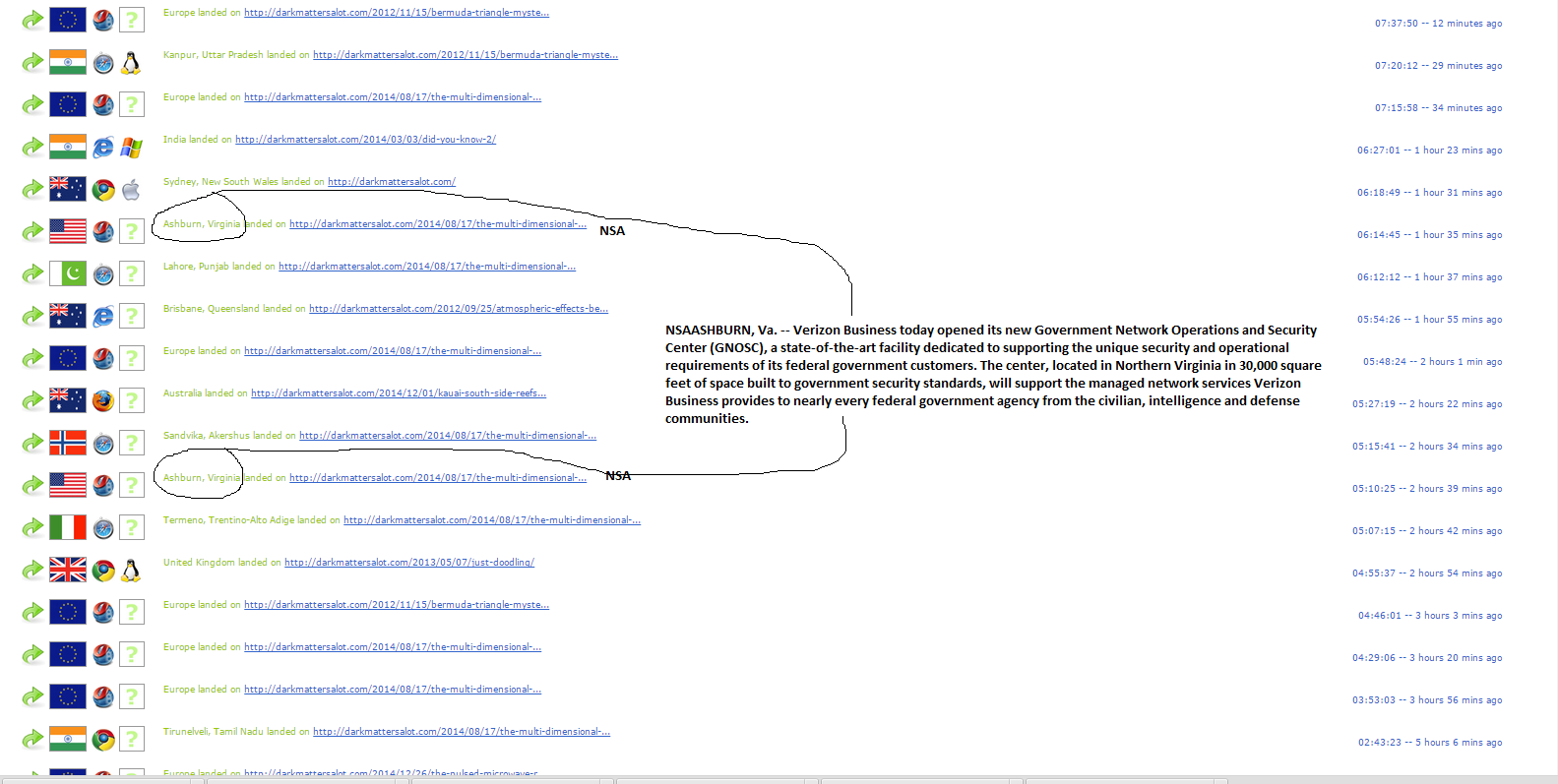
When the only visitors to your blog in the past 6 hours are from foreign countries and the NSA. Pray for me, OK guys?
I will be glad when this year is over

Most of the TDWR Radar Pulsed Power is being absorbed and/or reflected in the area of Hopewell High School


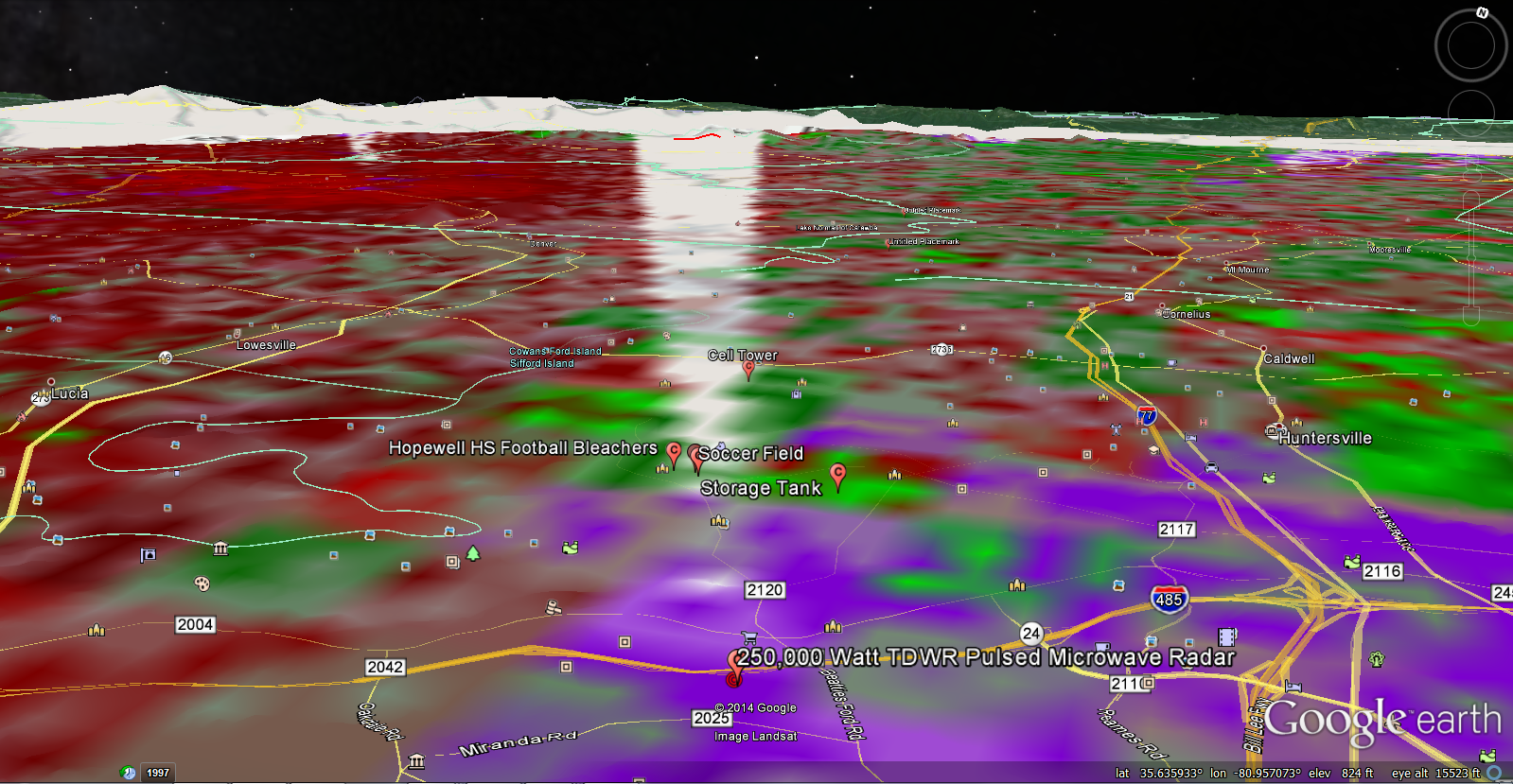

The Beam is not hitting the nearby water tank and the only cell tower is further away, after the beam power has already been absorbed/reflected.
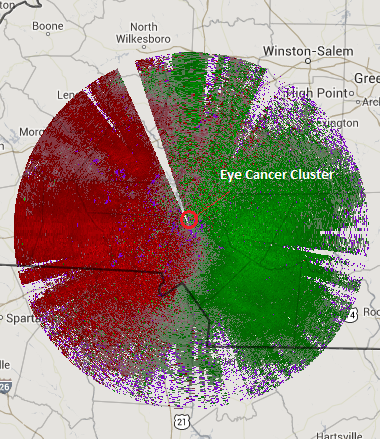
Figure 3. Pulsed Microwave TDWR Radar is hitting something at/near Hopewell High School

Figure 3.


Mystery shrouds possible eye cancer cluster in Huntersville
HUNTERSVILLE, N.C. —
Why are the velocity and reflectivity images missing northwest of the radar?
Unfortunately, a tower (I THINK IT MAY BE THE HIGH SCHOOL AND/OR BLEACHERS! THE TANK IS TO THE EAST) located northwest of the radar antenna blocks a portion of the radar transmission. The beam blockage results in missing to very poor quality data beyond the water tower, see Figure 3.
Figure 3. Beam blockage resulting in poor data along the 340 degree radial.
3. Where can I find current Charlotte TDWR velocity and reflectivity images?
Charlotte TDWR velocity, reflectivity, and Vertically Integrated Liquid are provided on the RIDGE II display.
FYI, I calculate “potential” peak pulsed power density in the overhead Huntersville area from the TDWR radar of
| Model | TDWR |
| Max Pulsed Power (Watts) | 250,000 |
| Gain (dBi) | 50 |
| EIRP | 25,000,000,000 |
| Frequency (MHz) | 5,575 |
| RPM | 5 |
| Max Pulsed Power Density (W/m2) @ 5 km | 70 Watts/sq. m (7000 uw/cm2) |
| Pulse Duration(uSec) | 1.1 |
| Pulse Repition Factor (Hz) | 2000 |
| Range Est. (Miles) | 56 |
| Latitude | 35.33733784 |
| Longitude | -80.88496241 |
| FIPS | Mecklenburg |
| County | NC |
| State | 37119 |
| Effective Date | 1994-1996 |
| Key | 3 |


 Dark Matters a Lot